

Deep dive · Performance and Core Web Vitals
Initpc Core Web Vitals: desktop passed, mobile work in progress
The Google PageSpeed Insights tests of 27 August 2026, published as they are: desktop with Core Web Vitals passed and a score of 95, mobile with INP at 289 ms and a failed assessment. Ongoing work, declared with its dates.
- ★ 4.7 · 38 Google reviews
- 25 years of experience
- ISO 9001 / ISO 27001
01 / The challenge
Making a 280,000-product catalogue fast on every device
Category pages full of products, filters, prices and stock, third-party scripts for reviews and payments, thousands of images: on desktop the infrastructure absorbs the weight, on a mid-range phone every kilobyte of JavaScript becomes blocking time and delays the response to a tap. We needed real measurements, not a convenient score, and a plan that started from users' field data.
- Core Web Vitals assessed on real visits, not in the lab
- Third-party scripts competing with the response to a tap
- Heavy category HTML and images on slow networks
02 / The solution
Desktop first, measured and passed; then mobile, work in progress
Multi-level cache, search outside the database, optimised images and lighter rendering brought desktop to pass the field Core Web Vitals. On mobile the report points to the causes — render-blocking requests, unused JavaScript, long tasks — and that is where we are intervening, one change at a time, with Lighthouse and Chrome DevTools.
Tools and technologies
Technologies and tools we used
- Google PageSpeed Insights and Chrome UX Report
- Lighthouse and Chrome DevTools
- Varnish and Redis for caching
- Image optimisation and lazy loading
- Critical CSS and deferred JavaScript (in progress)
- Third-party script reduction (in progress)
03 / The results
What we achieved
- 95 desktop performance score in the PageSpeed Insights report of 27/08/2026
- 77 ms ms of field INP on desktop, under the 200 ms threshold
- 53 mobile score on the same day: the work in progress, declared


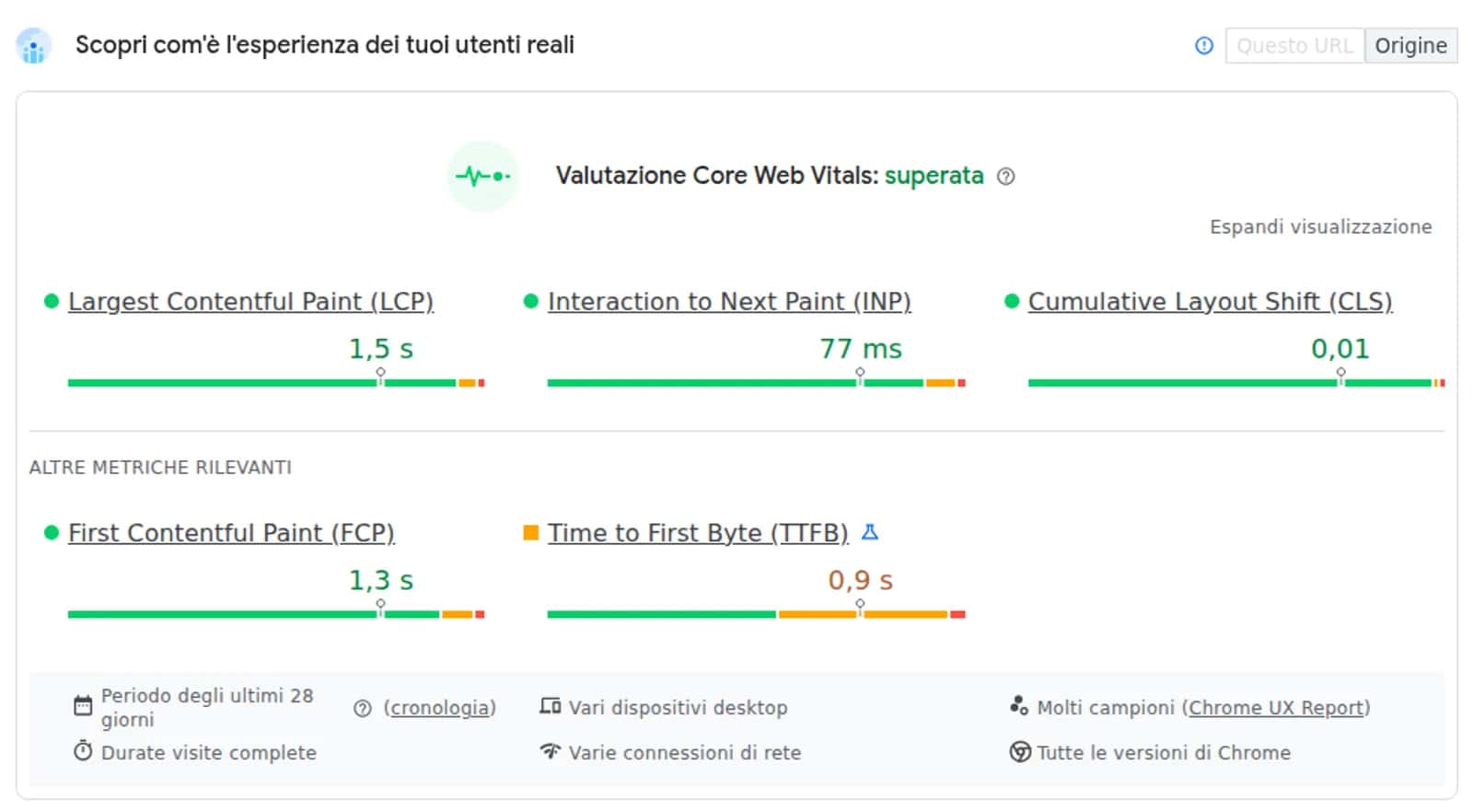
- Desktop: field Core Web Vitals assessment passed, LCP 1.5 s, INP 77 ms, CLS 0.01
- Mobile: cause identified in INP at 289 ms, with the seven diagnostic items turned into a work plan
- Reports published with dates and real screenshots: the page will be updated with subsequent tests
04 / Technology partners






- 25+ Years supporting businesses
- 4.7/5 Average rating on Google
- 38 Verified reviews
- ISO 9001/27001 ISO certifications
An e-commerce store with over 280,000 products is never made fast once and for all: it is made fast layer by layer, measured, and then the work resumes from wherever the numbers say it is not finished. On Initpc.it, the e-commerce we have supported as technical partner since 2006, performance work has proceeded exactly this way: desktop first, where the Core Web Vitals are now passed, then mobile, where the work is ongoing — and we say so.
This page shows the real Google PageSpeed Insights tests run on 27 August 2026, unfiltered: the desktop report and the mobile report, with field data from real users (Chrome UX Report, last 28 days) and lab data (Lighthouse). We prefer a declared work in progress to a convenient number.
It is one chapter of the Initpc case study: performance depends on everything underneath — the multi-level cache of the infrastructure and the search moved to Elasticsearch — and this page covers the last layer, the one the visitor sees.
How we measure: field data and lab data
PageSpeed Insights combines two different things. Field data comes from the Chrome UX Report: real user visits over the last 28 days, on real devices and connections, and this is what Google uses to assess the Core Web Vitals — Largest Contentful Paint (LCP), Interaction to Next Paint (INP) and Cumulative Layout Shift (CLS). Lab data is a single load simulated by Lighthouse on an emulated device with a throttled network: useful for diagnosis, not for judgement.
For an e-commerce store the former is what counts. Field data decides whether the Core Web Vitals assessment is "passed" or "failed", and that is where we look to decide where to intervene. Lab scores help us find the causes.
Desktop: Core Web Vitals passed
Desktop came first, because for an office-supplies store it is still the channel through which a good share of businesses buy. The report of 27 August 2026 gives this result.
| Desktop — 27/08/2026 | Value | Google threshold |
|---|---|---|
| Core Web Vitals assessment (field, 28 days) | passed | — |
| Field LCP | 1.5 s | ≤ 2.5 s |
| Field INP | 77 ms | ≤ 200 ms |
| Field CLS | 0.01 | ≤ 0.1 |
| Field FCP | 1.3 s | — |
| Field TTFB | 0.9 s | — |
| Performance score (lab) | 95 | — |
| Accessibility / Best practices / SEO | 92 / 92 / 100 | — |
In the lab, on an emulated desktop, the first content appears at 0.4 s, LCP at 1.5 s, Total Blocking Time is 40 ms and CLS 0.003. That is not a result you get from a caching plugin: it is the sum of Varnish serving already-generated pages, Redis saving database queries, optimised catalogue images and a search that no longer weighs on MariaDB.
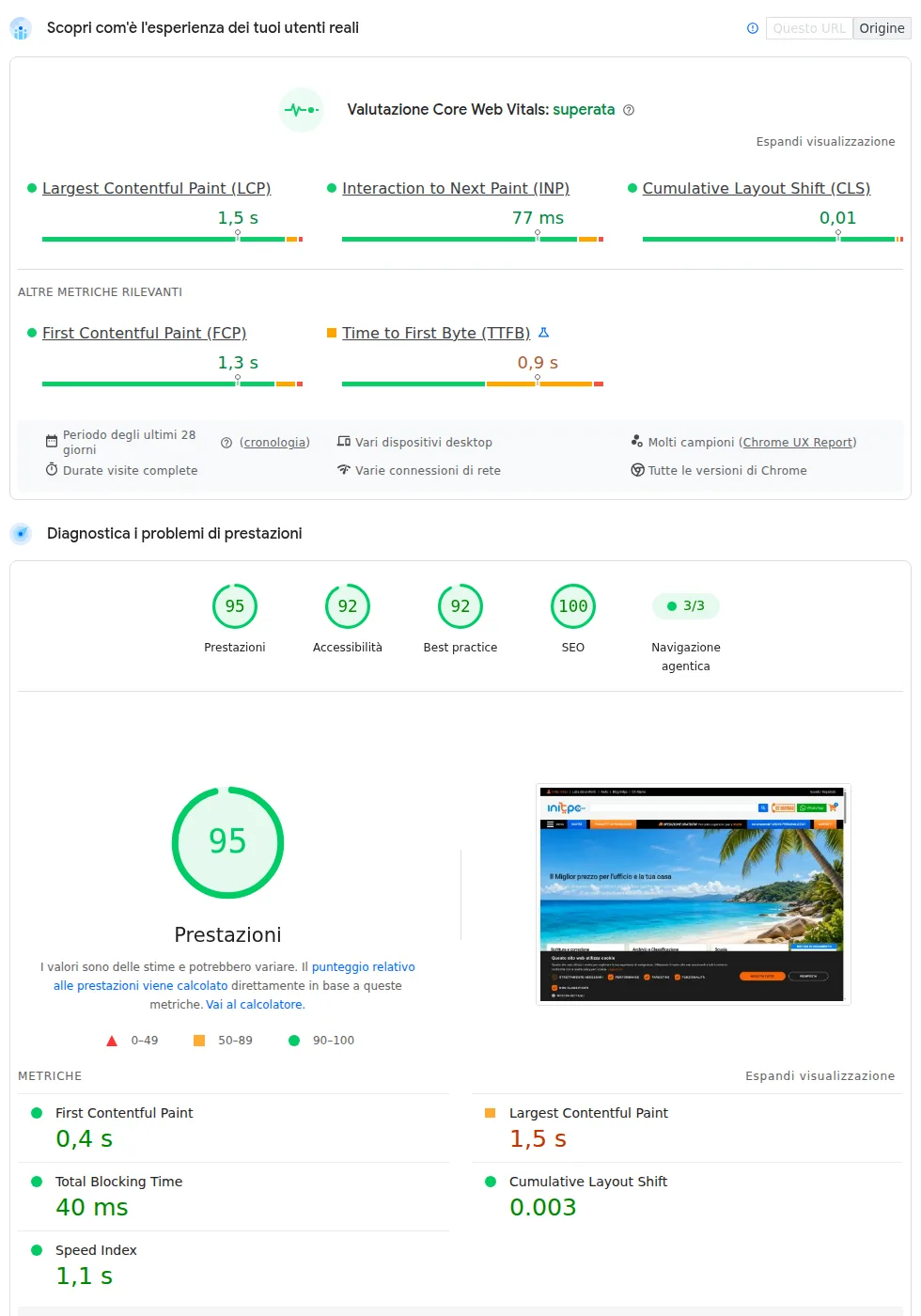
The same report lists what could still improve on desktop — images (estimated saving 1,174 KiB), render-blocking requests (450 ms), cache lifetimes (270 KiB) — and we take it as a to-do list, not as a dispute of the result.
Mobile: work in progress, declared
On mobile the picture is different, and we write it as it is. Same day, same page.
| Mobile — 27/08/2026 | Value | Google threshold |
|---|---|---|
| Core Web Vitals assessment (field, 28 days) | failed | — |
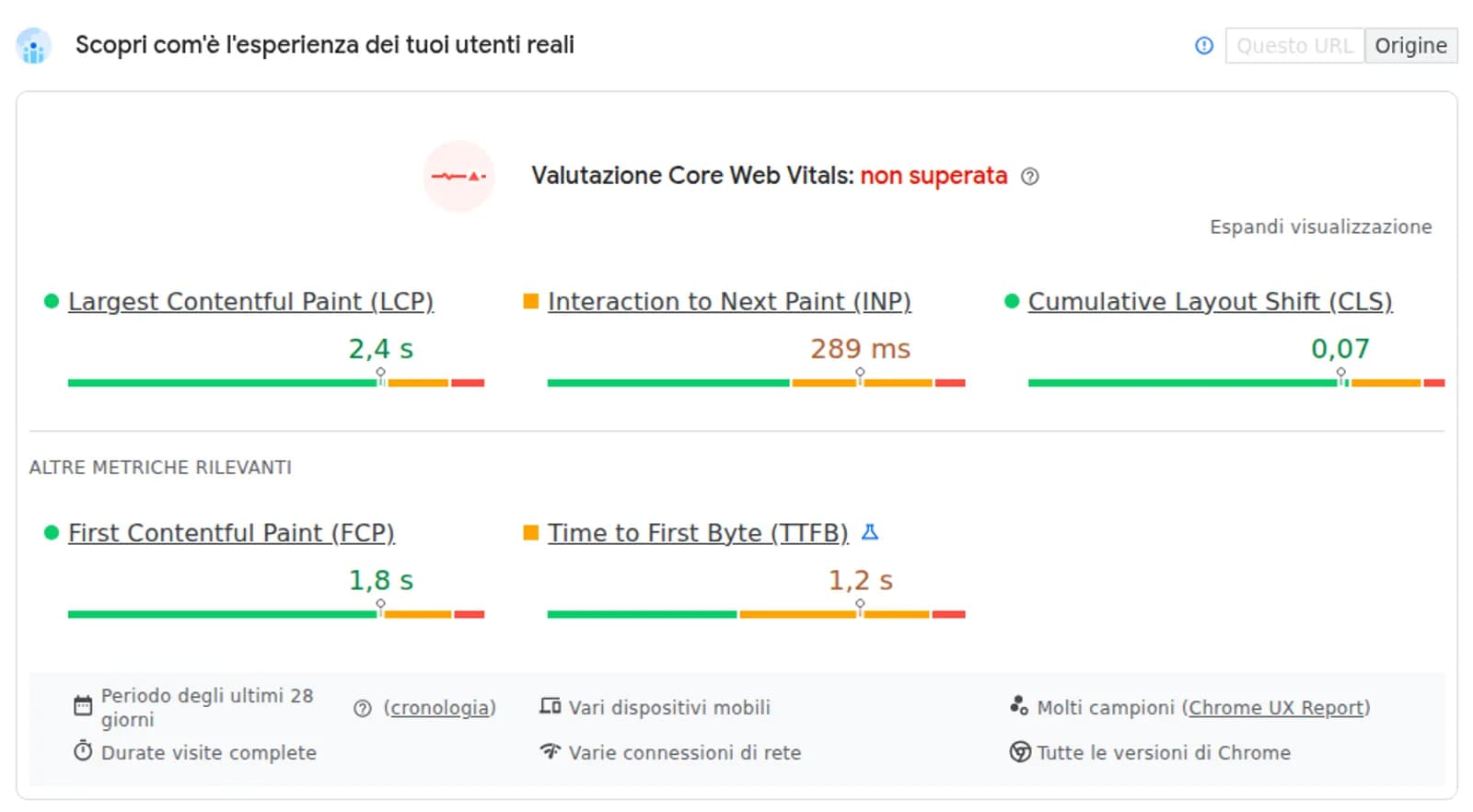
| Field LCP | 2.4 s | ≤ 2.5 s |
| Field INP | 289 ms | ≤ 200 ms |
| Field CLS | 0.07 | ≤ 0.1 |
| Field FCP | 1.8 s | — |
| Field TTFB | 1.2 s | — |
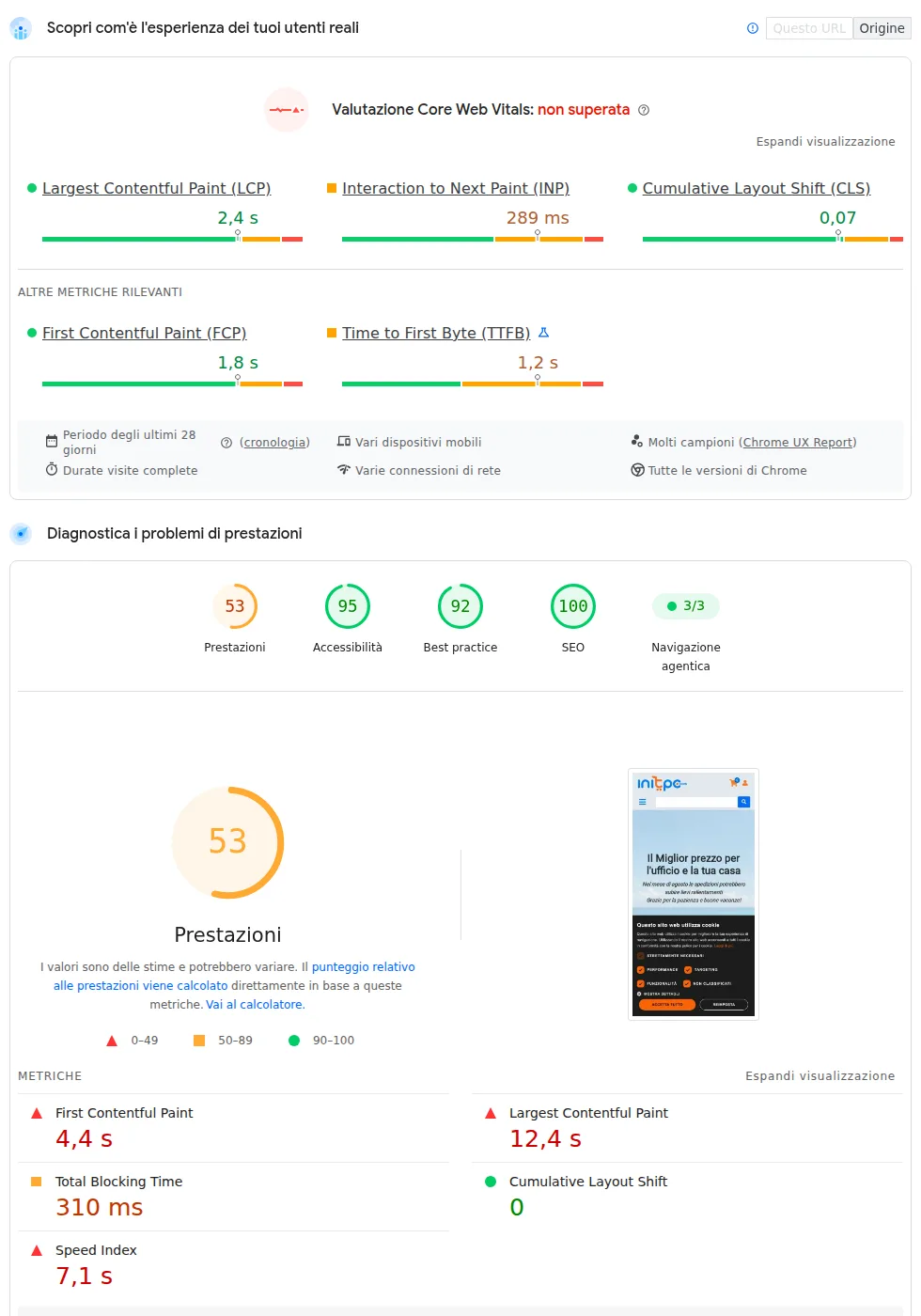
| Performance score (lab, emulated Moto G Power, slow 4G) | 53 | — |
| Accessibility / Best practices / SEO | 95 / 92 / 100 | — |
Field data says where the problem lies: LCP at 2.4 s is within the threshold by a hair, CLS is fine, while INP at 289 ms — the time between a tap and the visible response of the page — exceeds 200 ms and is what fails the assessment. In the lab, on an emulated mid-range phone with a slow 4G network, the picture is amplified: first content at 4.4 s, LCP at 12.4 s, Speed Index 7.1 s, 310 ms of main-thread blocking.
What the mobile diagnostics say and what we are working on
The mobile report pinpoints the causes, and they match the work plan in progress:
| Lighthouse finding (mobile) | Google's estimate | What we are doing |
|---|---|---|
| Render-blocking requests | 2,070 ms | Reduce CSS and JavaScript loaded before first paint: inline critical CSS for header and hero, defer the rest |
| Unused JavaScript | 565 KiB | Remove, or load on demand, plugin scripts not needed on the current page |
| Long main-thread tasks | 8 | The direct cause of INP: split long tasks, postpone third-party scripts until after interaction |
| Non-composited animations | 8 elements | Move animations to compositor-handled properties (transform, opacity) |
| Image delivery | 207 KiB | Mobile-specific sizes and formats, lazy loading for off-screen images |
| Cache lifetimes | 270 KiB | Longer cache times for static assets at the HAProxy/Varnish layer |
| Legacy JavaScript | 47 KiB | Stop serving polyfills to browsers that do not need them |
We work on desktop and mobile with the same method: one change at a time, measured with Lighthouse and Chrome DevTools on the real page, kept only if the numbers improve. The declared goal for mobile is to pass the field Core Web Vitals assessment — INP under 200 ms, LCP comfortably under 2.5 s — and we will update this page with the subsequent reports, with the same screenshots and the same dates.
Why mobile is harder on a large catalogue
Not an excuse, a technical observation. A category page with dozens of products, filters, prices and stock carries more HTML, more images and more scripts than a brochure page. On desktop, CPU and network absorb the weight; on a mid-range phone with a slow network every kilobyte of JavaScript becomes blocking time, and every third-party script — reviews, payments, analytics — competes with the response to the user's tap.
That is why mobile work is largely a work of subtraction: fewer scripts before first paint, less main-thread work, images at the right size. It is the same approach we followed on our own site, described in the case study from WordPress to a proprietary CMS.
What to expect if you run a similar e-commerce
That a Google test is not a final grade but a snapshot with a date. That field data matters more than the lab score. And that, on a large catalogue, speed comes from the architecture before the theme: cache at the right level, search outside the database, images governed upstream. That is the work we do in our business server support and e-commerce development services, and the full picture is in the full architecture of the Initpc project.
Live
The project as seen on the site
Frequently asked questions
The questions we get about this project
Why publish a mobile score of 53?
Because it is the real one as of 27 August 2026, and because the case study exists to show a method, not a showcase. Mobile field data says exactly what is wrong — INP at 289 ms — and the report points to the causes; publishing it commits us to updating the page once the ongoing work has changed the numbers.
Does the desktop score of 95 apply to the whole site?
The report covers the home page, as every PageSpeed Insights test does: one URL at a time. The "passed" Core Web Vitals assessment, however, comes from origin-level field data, i.e. real visits across all pages of the site over the last 28 days: the most representative figure Google makes available.
How long does it take to pass the Core Web Vitals on mobile?
It depends on the causes, which here are known: render-blocking scripts, unused JavaScript, long main-thread tasks. The interventions are under way and every change is measured before it stays. Field data updates over a 28-day window, so even an immediate lab improvement takes weeks to show in the assessment: that is why we date the reports and do not promise a deadline.
05 / Related services
The services behind these measurements
Systems support and e-commerce development: the pages that explain what we apply when a store has to become fast and stay fast.

Related articles
More case studies
Does your e-commerce fail the Core Web Vitals?
We tell you where the problem is starting from field data, not from the score: tell us about your store and show us the report.
06 / Talk to an expert
Talk to the people who built the Initpc architecture
Tell us about your catalogue, your platform and what no longer holds up: we call you back within one business day.
A senior consultant reviews the situation with you — infrastructure, search, data management, migration — and proposes the solution proportionate to the real scale of your store, with no obligation.