

Joomla CMS: Benefits and Features
Joomla is one of several platforms for building websites and web content: discover its features and benefits compared to other CMS options.

Joomla is an open-source CMS launched in 2005 that lets you build and manage dynamic websites through a graphical interface and a database, without needing to code from scratch. In previous articles we gave a general overview of CMS platforms and looked at how Drupal works; this time we're focusing on Joomla.
Joomla launched in 2005 as an open-source project: like other CMS platforms, it's a web platform that, thanks to a simple graphical interface and a database, lets you add, display, and manage multimedia and text content.
Joomla runs on a MySQL database and the PHP language, and its community currently counts roughly 220,000 users.
What Is Joomla Used For?
Joomla can be used to build and manage dynamic websites, to which features can be added whenever needed and whose appearance can be changed with ease.
Many sites offer free templates to download. The content management system behind Joomla ensures smooth operation, with many different options for displaying and organizing the content you create.
Why Choose Joomla?
There are plenty of good reasons to choose Joomla: first of all, it's a free platform, which means anyone who wants to build a website can use it. Those looking to build templates and extensions can also rely on Joomla by downloading the latest version from the official website.
Flexibility is another strength worth highlighting, along with the ease of use of its interface: it's not the most user-friendly CMS out there, but it's still usable even by people with limited technical skills or no knowledge of HTML and programming languages.
The Strengths of Joomla
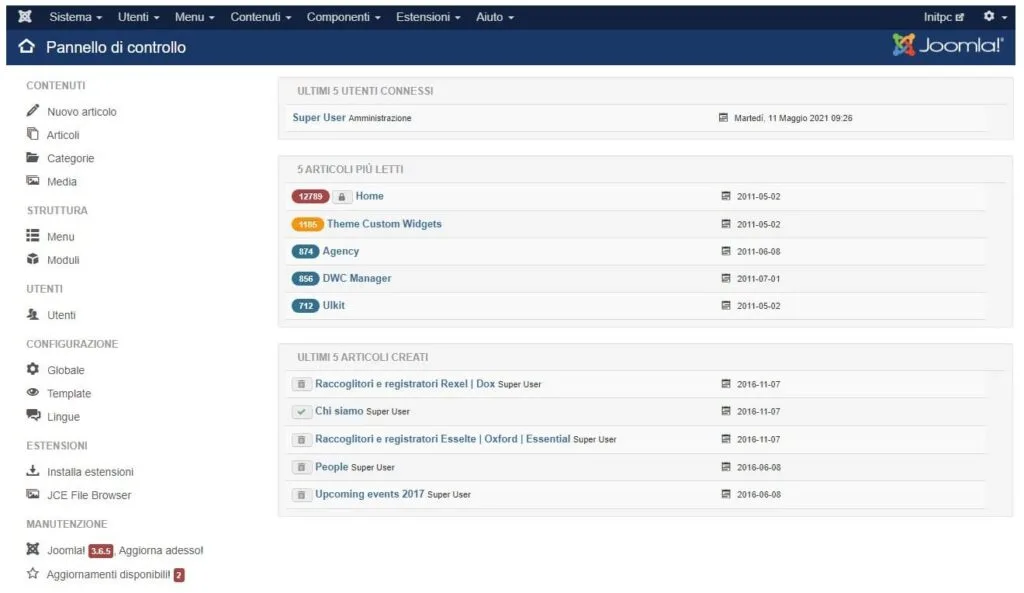
Native multilingual support and user-level management are two more points in Joomla's favor, alongside the large number of extensions available for installation.
It's also worth mentioning the fast learning curve and the visual quality of most templates — not just the paid ones, but also the many free options.
Finally, one detail not to overlook is that the community is open and welcoming to newcomers. That said, while it is possible to customize Joomla's code, doing so requires fairly advanced skills. On top of that, the many sub-category levels you could theoretically create end up being limited by the platform's architecture.
Joomla's Features
Joomla follows an architecture in which every article must be placed in a category or sub-category.
As a result, the structure-building process needs to be preceded by proper planning to organize it correctly: once the categories have been created, you can start adding the content that will later be displayed.
The core features are complemented by other useful tools, including photo galleries, calendars, and mailing-list sign-up modules, as well as social bookmarking.
With Joomla, you have access to over 5,000 downloadable components, including templates, modules, and plugins, most of which are available free of charge.
For those who have never used Joomla, the first steps can feel a bit tricky, if only because of the sheer variety of possible configurations. Over time, though, you'll find that managing its features is within anyone's reach: after all, the content-creation page isn't all that different from a basic word processor...
Joomla Support and Assistance
Your Solution Is Just a Click Away...

If you need help building a website, need another kind of IT support, or — more generally — any type of IT consulting, don't hesitate to contact us!
TN Solutions offers tailored solutions, with professionalism and transparency, for individuals and businesses alike, covering every kind of hardware, software, server, and systems administration need... and more!
Frequently asked questions
What is Joomla?
It's an open-source CMS launched in 2005, built on a MySQL database and the PHP language, that lets you build and manage dynamic websites through a graphical interface, with a community of around 220,000 users.
Why choose Joomla for your website?
Because it's free, flexible, supports native multilingual content and multiple user levels, and offers over 5,000 downloadable components among templates, modules, and plugins, most of them free.
Is Joomla suitable even for non-developers?
Yes — the content-creation interface is comparable to a common word processor; however, customizing the underlying code requires more advanced skills than basic platform use.
How is content organized in Joomla?
Every article must be placed in a category or sub-category, so a structure-planning phase is required before you start publishing content on the site.
Technology partners






Want to discuss it with our team?
We analyse your infrastructure for free and propose the most suitable solution.